https://mtp.linked.solutions/

http://xmlns.com/foaf/0.1/topic https://mtp.linked.solutions/cert

http://www.w3.org/ns/auth/cert#X509Certificate

http://www.w3.org/2003/06/sw-vocab-status/ns#term_status unstable
http://www.w3.org/2000/01/rdf-schema#label X509Certificate
http://www.w3.org/2000/01/rdf-schema#seeAlso http://en.wikipedia.org/wiki/X509
http://www.w3.org/2000/01/rdf-schema#isDefinedBy http://www.w3.org/ns/auth/cert#
http://www.w3.org/1999/02/22-rdf-syntax-ns#type http://www.w3.org/2002/07/owl#Class
http://www.w3.org/2000/01/rdf-schema#comment the class of X509 Certificates
http://www.w3.org/2000/01/rdf-schema#subClassOf http://www.w3.org/ns/auth/cert#Certificate

http://www.w3.org/ns/auth/cert#modulus

http://www.w3.org/2000/01/rdf-schema#range http://www.w3.org/2001/XMLSchema#base64Binary
http://www.w3.org/2001/XMLSchema#hexBinary
http://www.w3.org/2003/06/sw-vocab-status/ns#term_status unstable
http://www.w3.org/2000/01/rdf-schema#label modulus
http://www.w3.org/2000/01/rdf-schema#domain http://www.w3.org/ns/auth/cert#DSAKey
http://www.w3.org/ns/auth/cert#RSAKey
http://www.w3.org/2000/01/rdf-schema#isDefinedBy http://www.w3.org/ns/auth/cert#
http://www.w3.org/1999/02/22-rdf-syntax-ns#type http://www.w3.org/2002/07/owl#DatatypeProperty
http://www.w3.org/2000/01/rdf-schema#comment

The modulus of an RSA public and private key. Or the modulus of a DSA Key. The modulus is encoded as a hex binary. The binary is the same as the one encoded in the XML DSIG CryptoBinary

This specification defines the ds:CryptoBinary simple type for representing arbitrary-length integers (e.g. "bignums") in XML as octet strings. The integer value is first converted to a "big endian" bitstring. The bitstring is then padded with leading zero bits so that the total number of bits == 0 mod 8 (so that there are an integral number of octets). If the bitstring contains entire leading octets that are zero, these are removed (so the high-order octet is always non-zero).

The only difference is that the octet string is then encoded using either xsd:base64Binary or xsd:hexBinary. Currently for all usages of this relation, the xsd:hexBinary datatype should be used until the SPARQL working group specifies specifies in its D-Entailment that those two types are equivalent.

It would have been better had there been a hexInteger datatype that was standard and supported by all tools.

http://www.w3.org/ns/auth/cert#PGPCertificate

http://www.w3.org/2003/06/sw-vocab-status/ns#term_status unstable
http://www.w3.org/2000/01/rdf-schema#label PGPCertificate
http://www.w3.org/2000/01/rdf-schema#isDefinedBy http://www.w3.org/ns/auth/cert#
http://www.w3.org/2002/07/owl#equivalentClass http://xmlns.com/wot/0.1/PubKey
http://www.w3.org/1999/02/22-rdf-syntax-ns#type http://www.w3.org/2002/07/owl#Class
http://www.w3.org/2000/01/rdf-schema#comment the class of PGP Certificates
http://www.w3.org/2000/01/rdf-schema#subClassOf http://www.w3.org/ns/auth/cert#Certificate

http://www.w3.org/ns/auth/cert#privateExponent

http://www.w3.org/2000/01/rdf-schema#range http://www.w3.org/2001/XMLSchema#nonNegativeInteger
http://www.w3.org/2003/06/sw-vocab-status/ns#term_status unstable
http://www.w3.org/2000/01/rdf-schema#label private
http://www.w3.org/2000/01/rdf-schema#domain http://www.w3.org/ns/auth/cert#RSAPrivateKey
http://www.w3.org/2000/01/rdf-schema#isDefinedBy http://www.w3.org/ns/auth/cert#
http://www.w3.org/1999/02/22-rdf-syntax-ns#type http://www.w3.org/2002/07/owl#DatatypeProperty
http://www.w3.org/2000/01/rdf-schema#comment The exponent used to decrypt the message calculated as public_exponent*private_exponent = 1 modulo totient(p*q) The private exponent is often named 'd'

http://www.w3.org/ns/auth/cert#exponent

http://www.w3.org/2000/01/rdf-schema#range http://www.w3.org/2001/XMLSchema#nonNegativeInteger
http://www.w3.org/2003/06/sw-vocab-status/ns#term_status unstable
http://www.w3.org/2000/01/rdf-schema#label exponent
http://www.w3.org/2000/01/rdf-schema#domain http://www.w3.org/ns/auth/cert#RSAPublicKey
http://www.w3.org/2000/01/rdf-schema#isDefinedBy http://www.w3.org/ns/auth/cert#
http://www.w3.org/1999/02/22-rdf-syntax-ns#type http://www.w3.org/2002/07/owl#DatatypeProperty
http://www.w3.org/2000/01/rdf-schema#comment The exponent used to encrypt the message. Number chosen between 1 and the totient(p*q). Often named 'e' .

http://www.w3.org/ns/auth/cert#Signature

http://www.w3.org/2003/06/sw-vocab-status/ns#term_status unstable
http://www.w3.org/2000/01/rdf-schema#label Signature
http://www.w3.org/2000/01/rdf-schema#isDefinedBy http://www.w3.org/ns/auth/cert#
http://www.w3.org/1999/02/22-rdf-syntax-ns#type http://www.w3.org/2002/07/owl#Class
http://www.w3.org/2000/01/rdf-schema#comment the class of signtatures

http://www.w3.org/ns/auth/cert#PrivateKey

http://www.w3.org/2000/01/rdf-schema#label PrivateKey
http://www.w3.org/2000/01/rdf-schema#isDefinedBy http://www.w3.org/ns/auth/cert#
http://www.w3.org/1999/02/22-rdf-syntax-ns#type http://www.w3.org/2002/07/owl#Class
http://www.w3.org/2000/01/rdf-schema#comment Private Key
http://www.w3.org/2000/01/rdf-schema#subClassOf http://www.w3.org/ns/auth/cert#Key

http://www.w3.org/ns/auth/cert#hex

http://www.w3.org/2003/06/sw-vocab-status/ns#term_status archaic
http://www.w3.org/2000/01/rdf-schema#label hexadecimal
http://www.w3.org/2000/01/rdf-schema#seeAlso http://en.wikipedia.org/wiki/Hexadecimal
http://www.w3.org/2002/07/owl#equivalentClass http://www.w3.org/2001/XMLSchema#nonNegativeInteger
http://www.w3.org/2000/01/rdf-schema#isDefinedBy http://www.w3.org/ns/auth/cert#
http://www.w3.org/1999/02/22-rdf-syntax-ns#type http://www.w3.org/2000/01/rdf-schema#Datatype
http://www.w3.org/2000/01/rdf-schema#comment

An encoding of a positive integer (from 0 to infinity) as a hexadecimal string that makes it easy to read and/or fun to present on the web.

The purpose of this way of representing hexadecimals is to enable users to copy and paste hexadecimal notations as shown by most browsers, keychains or tools such as opensso, into their rdf representation of choice. There are a wide variety of ways in which such strings can be presented. One finds the following:

  e1 dc d5 e1 00 8f 21 5e d5 cc 7c 7e c4 9c ad 86 
  64 aa dc 29 f2 8d d9 56 7f 31 b6 bd 1b fd b8 ee 
  51 0d 3c 84 59 a2 45 d2 13 59 2a 14 82 1a 0f 6e 
  d3 d1 4a 2d a9 4c 7e db 90 07 fc f1 8d a3 8e 38 
  25 21 0a 32 c1 95 31 3c ba 56 cc 17 45 87 e1 eb 
  fd 9f 0f 82 16 67 9f 67 fa 91 e4 0d 55 4e 52 c0 
  66 64 2f fe 98 8f ae f8 96 21 5e ea 38 9e 5c 4f 
  27 e2 48 ca ca f2 90 23 ad 99 4b cc 38 32 6d bf  

Or the same as the above, with ':' instead of spaces. We can't guarantee that these are the only ways such tools will present hexadecimals, so we are very lax.

The letters can be uppercase or lowercase, or mixed.

Some strings may start with initial 00's, and can be stripped in this notation as they often are. Doing this could, in complement of 2 notation turn a positive number into a negative one, if the first hexadecimal character happens to be one of the set {'8', '9', 'a', 'A', 'b', 'B', 'c', 'C', 'd', 'D', 'e', 'E', 'f', 'F'} . As we interpret this string as a hexadecimal number leading 00s are not important (Complement of 2 notation and hexadecimal overlap for positive numbers)

In order to make this fun, we allow any unicode characters in the string. A parser should

  1. remove all non hexadecimal characters
  2. treat the resulting as a hexadecimal representation of a number

This will allow people to make an ascii - better yet a UTF-8 - picture of their public key when publishing it on the web.

Cert hex is also a datatype property because we used to write it out like this

   [] a rsa:RSAPublicKey;
     rsa:public_exponent [ cert:hex "e1 dc d5 ..."] 
 

The above notation is now deprecated. Now we prefer the literal format below.

   [] a rsa:RSAPublicKey;
     rsa:public_exponent "e1 dc d5 ..."^^cert:hex .
 
http://www.w3.org/2004/02/skos/core#editorialNote

This relation should slowly be transited to just being a datatype.

Being a datatype and a property is legal as explained here on the semantic web mailing list in March 2010. But it may be somewhat confusing, especially if it goes against a pattern - still to be set - by the xsd datatypes as the follow up email makes clear.

http://www.w3.org/ns/auth/cert#Certificate

http://www.w3.org/2003/06/sw-vocab-status/ns#term_status unstable
http://www.w3.org/2000/01/rdf-schema#label Certificate
http://www.w3.org/2000/01/rdf-schema#isDefinedBy http://www.w3.org/ns/auth/cert#
http://www.w3.org/1999/02/22-rdf-syntax-ns#type http://www.w3.org/2002/07/owl#Class
http://www.w3.org/2000/01/rdf-schema#comment A certificate is a Document that is signed. As explained here http://www.pgpi.org/doc/pgpintro/#p16 'A digital certificate consists of three things: * A public key. * Certificate information. ('Identity' information about the user, such as name, user ID, and so on.) * One or more digital signatures.'
http://www.w3.org/2000/01/rdf-schema#subClassOf http://xmlns.com/foaf/0.1/Document

http://www.w3.org/ns/auth/cert#RSAKey

http://www.w3.org/2003/06/sw-vocab-status/ns#term_status unstable
http://www.w3.org/2000/01/rdf-schema#label RSA Key
http://www.w3.org/2000/01/rdf-schema#isDefinedBy http://www.w3.org/ns/auth/cert#
http://www.w3.org/1999/02/22-rdf-syntax-ns#type http://www.w3.org/2002/07/owl#Class
http://www.w3.org/2000/01/rdf-schema#comment The union of the public and private components of an RSAKey. Usually those pieces are not kept together
http://www.w3.org/2000/01/rdf-schema#subClassOf http://www.w3.org/ns/auth/cert#Key

http://www.w3.org/ns/auth/cert#RSAPublicKey

http://www.w3.org/2003/06/sw-vocab-status/ns#term_status unstable
http://www.w3.org/2000/01/rdf-schema#label RSA Public Key
http://www.w3.org/2000/01/rdf-schema#seeAlso http://en.wikipedia.org/wiki/RSA
http://www.w3.org/2000/01/rdf-schema#isDefinedBy http://www.w3.org/ns/auth/cert#
http://www.w3.org/1999/02/22-rdf-syntax-ns#type http://www.w3.org/2002/07/owl#Class
http://www.w3.org/2000/01/rdf-schema#comment The RSA public key. Padded message m are encrypted by applying the function modulus(power(m,exponent),modulus)
http://www.w3.org/2000/01/rdf-schema#subClassOf http://www.w3.org/ns/auth/cert#PublicKey
http://www.w3.org/ns/auth/cert#RSAKey

http://www.w3.org/ns/auth/cert#

http://www.w3.org/2003/06/sw-vocab-status/ns#term_status unstable
http://purl.org/dc/terms/created 2008-11-13
http://www.w3.org/2000/01/rdf-schema#label Ontology for Certificates and crypto stuff.
http://www.w3.org/2000/01/rdf-schema#seeAlso http://www.w3.org/ns/auth/rsa
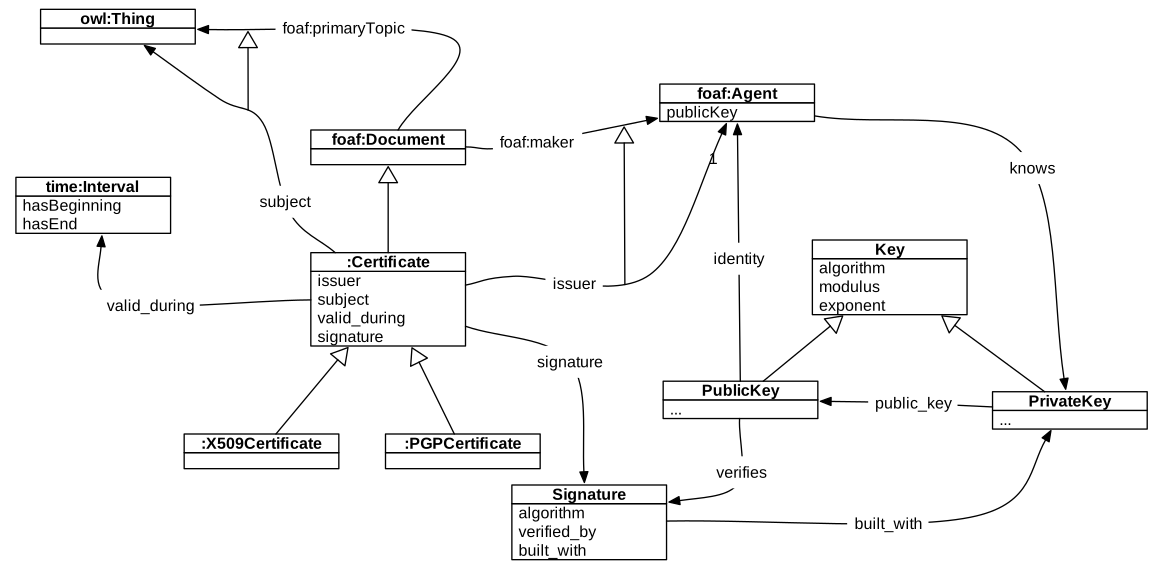
http://www.w3.org/ns/auth/X509Uml.svg
http://lists.foaf-project.org/mailman/listinfo/foaf-protocols
http://www.w3.org/1999/02/22-rdf-syntax-ns#type http://www.w3.org/2002/07/owl#Ontology
http://www.w3.org/2000/01/rdf-schema#comment Ontology for Certificates and crypto stuff. This is in development. Some other ontologies to look at: * http://www.w3.org/2000/10/swap/crypto + has cwm builtins: http://www.w3.org/2000/10/swap/doc/Trust - a bit old perhaps. It imports daml+oil - would help to be more completely specified - uses literals as subjects a little liberally, which makes this a bit difficult to work with frameworks that don't permit this * http://xmlns.com/wot/0.1/ - limited very much to PGP (though on can map PGP to X509) - a little coarse grained, mixes up the PGP certificate with the PGP public key * Todo: - add some classes and relations for DSA - should this all be in one file? Or should this be cut up a little? Say one file for the general CERT ontology, and then files for RSA, DSA, PGP, etc... Or perhaps it does not really matter? - expand more on the certification side of things - verify this by security experts - owl2 has some constructs for combined inverse functional properties. This may be useful to use in defining an RSA key which is identified by two numbers. - also create html version of the spec by using this as a template. - should comments such as this be in html?
http://xmlns.com/foaf/0.1/maker http://bblfish.net/people/henry/card#me

http://www.w3.org/ns/auth/cert#PublicKey

http://www.w3.org/2003/06/sw-vocab-status/ns#term_status unstable
http://www.w3.org/2000/01/rdf-schema#label PublicKey
http://www.w3.org/2000/01/rdf-schema#isDefinedBy http://www.w3.org/ns/auth/cert#
http://www.w3.org/1999/02/22-rdf-syntax-ns#type http://www.w3.org/2002/07/owl#Class
http://www.w3.org/2000/01/rdf-schema#comment Public Key
http://www.w3.org/2000/01/rdf-schema#subClassOf http://www.w3.org/ns/auth/cert#Key

https://mtp.linked.solutions/cert

http://purl.org/dc/terms/source https://github.com/linked-solutions/prefix.cc-harvest/master
http://www.w3.org/1999/02/22-rdf-syntax-ns#type http://www.w3.org/2002/07/owl#Ontology
http://purl.org/vocab/vann/preferredNamespaceUri http://www.w3.org/ns/auth/cert#
http://purl.org/vocab/vann/preferredNamespacePrefix cert
http://rdfs.org/ns/void#triples 114

http://www.w3.org/ns/auth/cert#Key

http://www.w3.org/2003/06/sw-vocab-status/ns#term_status unstable
http://www.w3.org/2000/01/rdf-schema#isDefinedBy http://www.w3.org/ns/auth/cert#
http://www.w3.org/1999/02/22-rdf-syntax-ns#type http://www.w3.org/2002/07/owl#Class
http://www.w3.org/2000/01/rdf-schema#comment the class of keys

http://www.w3.org/ns/auth/cert#key

http://www.w3.org/2000/01/rdf-schema#range http://www.w3.org/ns/auth/cert#PublicKey
http://www.w3.org/ns/auth/cert#Key
http://www.w3.org/2003/06/sw-vocab-status/ns#term_status unstable
http://www.w3.org/2000/01/rdf-schema#label key
http://www.w3.org/2000/01/rdf-schema#domain http://xmlns.com/foaf/0.1/Agent
http://www.w3.org/2002/07/owl#inverseOf http://www.w3.org/ns/auth/cert#identity
http://www.w3.org/2000/01/rdf-schema#isDefinedBy http://www.w3.org/ns/auth/cert#
http://www.w3.org/1999/02/22-rdf-syntax-ns#type http://www.w3.org/1999/02/22-rdf-syntax-ns#Property
http://www.w3.org/2002/07/owl#ObjectProperty
http://www.w3.org/2002/07/owl#InverseFunctionalProperty
http://www.w3.org/2000/01/rdf-schema#comment relates an agent to a key - most often the public key.

http://www.w3.org/ns/auth/cert#identity

http://www.w3.org/2003/06/sw-vocab-status/ns#term_status archaic
http://www.w3.org/2000/01/rdf-schema#label identity
http://www.w3.org/2000/01/rdf-schema#domain http://www.w3.org/ns/auth/cert#PublicKey
http://www.w3.org/2002/07/owl#inverseOf http://www.w3.org/ns/auth/cert#key
http://www.w3.org/2000/01/rdf-schema#isDefinedBy http://www.w3.org/ns/auth/cert#
http://www.w3.org/1999/02/22-rdf-syntax-ns#type http://www.w3.org/1999/02/22-rdf-syntax-ns#Property
http://www.w3.org/2002/07/owl#ObjectProperty
http://www.w3.org/2000/01/rdf-schema#comment the identity of the public key. This is the entity that knows the private key and so can decrypt messages encrypted with the public key, or encrypt messages that can be decrypted with the public key.
http://www.w3.org/2004/02/skos/core#editorialNote It turns out that this relation is unintuitive to write out and to name. One should instead use cert:key