http://purl.org/net/ns/wordmap#SubjectIndicator |
|
http://www.w3.org/2000/01/rdf-schema#label
|
Subject Indicator
|
|
http://www.w3.org/2000/01/rdf-schema#isDefinedBy
|
http://purl.org/net/ns/wordmap
|
|
http://www.w3.org/1999/02/22-rdf-syntax-ns#type
|
http://www.w3.org/2002/07/owl#Class
|
|
http://www.w3.org/2000/01/rdf-schema#comment
|
An information resource which provides some kinds of description of a 'subject' (for human), as well as identifies the 'subject' (for applications), whose URI works as value of an Inverse Functional Property (namely, foaf:isPrimaryTopicO) for the 'subject'. In other words, SubjectIndicator is a document whose foaf:primaryTopic is the 'subject'. |
| 主題の説明を持つとともに、主題を識別する役割も果たす情報リソース。URIはIFP(たとえばfoaf:isPrimaryTopicOf)の目的語として主題を識別することができる。言い換えれば、SubjectIndicatorとはそのfoaf:primaryTopicが対象主題である文書。
|
|
http://www.w3.org/2000/01/rdf-schema#subClassOf
|
http://xmlns.com/foaf/0.1/Document
|
http://purl.org/net/ns/wordmap#example3 |
|
http://purl.org/net/ns/ex#image
|
http://www.kanzaki.com/works/2007/misc/wordmap-vocab-sample3.png
|
|
http://purl.org/net/ns/ex#code
|
2007-10-18
|
|
http://purl.org/net/ns/ontology-annot#relation
|
http://tomgruber.org/writing/ontology-of-folksonomy.htm |
| http://www.holygoat.co.uk/projects/tags/
|
|
http://purl.org/net/ns/ex#exampleOf
|
http://purl.org/net/ns/wordmap
|
|
http://www.w3.org/1999/02/22-rdf-syntax-ns#type
|
http://purl.org/net/ns/ex#Example
|
|
http://www.w3.org/2000/01/rdf-schema#comment
|
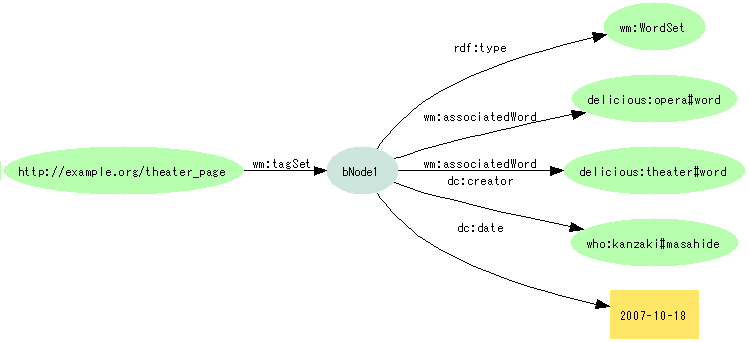
ある人がdel.icio.usにおいて、あるページに'opera'と'theater'というタグをつけたことをあらわす例。これはRichard NewmanのTag OntologyやTom GruberのOntology of Folksonomyとよく似たモデルになる。dc:creatorは誰がタグを与えたか、dc:dateはいつ与えたかを示す。ここで、wm:asscociatedWordがWordSetと結びつけるのは、語リソースであることに注意。 |
| An example to express that someone tagged a document with a set of tags 'opera' and 'theater' in del.icio.us. This is quite similar to such models as Richard Newman's Tag Ontology and Tom Gruber's Ontology of Folksonomy. In this case, dc:creator asserts who gave this tag set to the document, and dc:date asserts when. Note that wm:asscociatedWord relates Word Set and 'word resource'.
|
|
http://purl.org/net/ns/ex#pfx
|
wm:
|
http://purl.org/net/ns/wordmap#example1 |
|
http://purl.org/net/ns/ex#image
|
http://www.kanzaki.com/works/2007/misc/wordmap-vocab-sample1.png
|
|
http://purl.org/net/ns/ex#code
|
|
|
http://purl.org/net/ns/ex#exampleOf
|
http://purl.org/net/ns/wordmap
|
|
http://www.w3.org/1999/02/22-rdf-syntax-ns#type
|
http://purl.org/net/ns/ex#Example
|
|
http://www.w3.org/2000/01/rdf-schema#comment
|
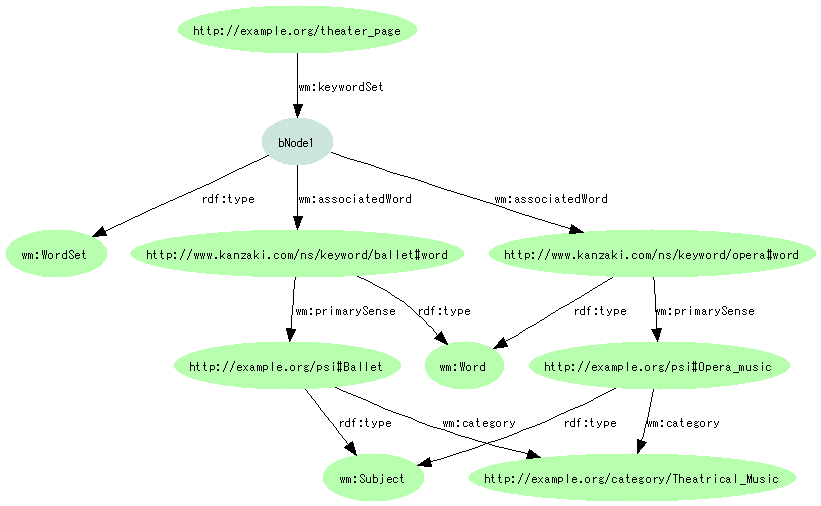
あるページの'opera'というキーワードにURIを与え、複数のトピック/概念に結びつける例。キーワード'opera'は2つの主題'Opera_music'と'Opera_browser'に関連しており、それぞれの主題は対応するWikipediaページに説明文がある。このグラフは、文書のキーワードが実際はどちらの主題に対応するかについては何も言明しないことに注意。文書からメタデータを収集するエージェントが、文字列としてのキーワードしかない文書を扱うときなどに利用できる。あいまいさが解決された場合の記述は例4を参照。 |
| An example to state that a document has a keyword 'opera', and to provide a URI for the keyword, and link it to multiple 'Subjects'. A keyword 'opera' is connected to two subjects 'Opera_music' and 'Opera_browser', and each subject is described by an Wikipedia page. Note, this graph does not say anything regarding which is the true subject of the document. This might be useful when an agent tries to extract metadata from a document which only states literal keywords, not identifiable subjects. See Example 4 for description in case the disambiguation is resolved.
|
|
http://purl.org/net/ns/ex#pfx
|
wm:
|
http://purl.org/net/ns/wordmap#example4 |
|
http://purl.org/net/ns/ex#code
|
Opera
|
|
http://purl.org/net/ns/ex#exampleOf
|
http://purl.org/net/ns/wordmap
|
|
http://www.w3.org/1999/02/22-rdf-syntax-ns#type
|
http://purl.org/net/ns/ex#Example
|
|
http://www.w3.org/2000/01/rdf-schema#comment
|
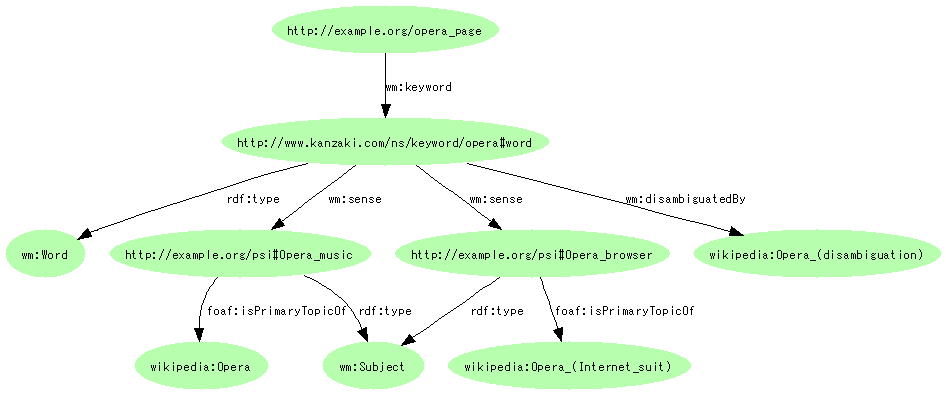
【変更の可能性あり】ある文書に出現する語句が何らかの方法で曖昧さ解決されて、主題リソースに結び付けられる例。あいまいさが解決されないキーワードを2つの主題に結び付けている例1と比較してみよう。さらに、このトピックは実際は文書中の複数箇所にフレーズとして出現している。これは、「ある文書はあるトピックの出現であるフレーズを(複数)持つ」という形で表現できる。文書のインデクスを生成して、そこから実際のフレーズへのリンクを提供するようなアプリケーションで利用できるかもしれない。 |
| [Experimental: subject to change] An example to express that a key term (topic) in a document is disambiguated (by some methods), and related to 'subject' resource. Compare this to Example 1, where ambiguous keyword 'opera' is related to two possible 'subjects'. Also, a topic actually appears multiple places in a document. This could be expressed as 'a document has some components which are occurrences of a topic'. This expression would be useful for an application that generates an Index of a document and provides links from the index to each occurrences in a document.
|
|
http://purl.org/net/ns/ex#pfx
|
wm:
|
http://purl.org/net/ns/wordmap#Subject |
|
http://www.w3.org/2000/01/rdf-schema#label
|
Subject
|
|
http://www.w3.org/2000/01/rdf-schema#isDefinedBy
|
http://purl.org/net/ns/wordmap
|
|
http://www.w3.org/1999/02/22-rdf-syntax-ns#type
|
http://www.w3.org/2002/07/owl#Class
|
|
http://www.w3.org/2000/01/rdf-schema#comment
|
主題。キーワードはその主題を表す語(のひとつ)。ひとつの主題は複数のキーワードで表されることがある(例:音楽舞台芸術の1分野であるトピックに対して、opera、歌劇という異なるキーワードが対応する)。主題は個人(個体)でも、集合体でも、抽象的概念でも何でもよく、Topic Mapsの主題(subject)と同様、記述の対象となるどんなものでも表すことができる(なお、「概念」はSKOSで定義されているように抽象的な考えに対応し、主題ではあっても概念とはいいがたいキーワードもある)。 |
| A 'subject' of discourse which a (key)word represents (is a lexical form of). A 'subject' may be represented by multiple (key)words, such as 'opera' and 'Oper'. A 'subject' can be an individual, a class of individuals or an abstract concept: any 'subject' of discourse as defined in Topic Maps subjet. (note: a 'concept' is an abstract idea or notion as defined in SKOS, and some keywords would not match a concept)
|
http://purl.org/net/ns/wordmap |
|
http://purl.org/net/ns/ontology-annot#modified
|
2008-06-21
|
|
http://purl.org/net/ns/ontology-annot#relation
|
http://www.kanzaki.com/ns/keyword/
|
|
http://www.w3.org/2002/07/owl#imports
|
http://www.kanzaki.com/ns/dliser.rdf
|
|
http://www.w3.org/2000/01/rdf-schema#label
|
Word to Subject Mapping Vocabulary
|
|
http://www.w3.org/1999/02/22-rdf-syntax-ns#type
|
http://www.w3.org/2002/07/owl#Ontology
|
|
http://purl.org/net/ns/ontology-annot#created
|
2007-07-04
|
|
http://www.w3.org/2002/07/owl#versionInfo
|
Version 0.95. Note: terms marked [TESTING] are subject to change.
|
|
http://www.w3.org/2000/01/rdf-schema#comment
|
Vocabulary to bridge literal keywords and subjects behind them. Not only single word, but also a set of words can be related to a subject. Further, the subject may be linked to some descriptive pages. Since a natural language word could be polysemic, it is important to distinguish literal keywords and the subjects of a document. |
| 文字列のキーワードとその言葉が表す主題を結びつけるための語彙。ひとつの語に限らず、複数の語の集合を主題に結びつけることもできる。さらにその主題を、その説明を記述した文書とリンクさせることもできる。自然言語によるキーワードは多義語の場合があるので、文書のキーワードと主題を区別して考えることが重要。
|
|
http://purl.org/net/ns/ontology-annot#creator
|
urn:pin:MK705
|